
Help & Support with Domestic Abuse

Measures announced over recent weeks to tackle coronavirus (COVID-19) have seen people’s day-to-day life be drastically altered. These changes are essential to beat coronavirus and protect our NHS.

Here at Kenilworth Watch we recognise that staying at home can cause anxiety for those who are experiencing or feel at risk of domestic abuse. Domestic abuse is unacceptable in any situation, no matter what stresses you are under.

For anyone who feels they are at risk of abuse, it is important to remember that there is help and support available to you. Guidance is also available to help perpetrators change their behaviour.

There are a number of charities who are providing advice and guidance during this challenging time. Please see below for details and links to the organisations providing help and support.

National Domestic Abuse Helpline

The National Domestic Abuse Helpline website provides guidance and support for potential victims, as well as those who are worried about friends and loved ones. They can also be called, for free and in confidence, 24 hours a day on 0808 2000 247. The website also has a form through which women can book a safe time for a call from the team.

Women’s Aid

Women’s Aid has provided additional advice specifically designed for the current COVID-19 outbreak, including a live chat service.

Men’s Advice Line

The Men’s Advice Line is a confidential helpline for male victims of domestic abuse and those supporting them. It can be contacted on 0808 801 0327.

Galop – for members of the LGBT+ community

If you are a member of the LGBT+ community, Galop runs a specialist helpline on 0800 999 5428 or email help@galop.org.uk.

Economic abuse

If you are concerned about how COVID-19 may affect your finances and leave you vulnerable to economic abuse, please see the advice provided by HM Treasury on what support is on offer. The charity Surviving Economic Abuse has also provided additional guidance and support.

Hestia

Hestia provides a free-to-download mobile app, Bright Sky, which provides support and information to anyone who may be in an abusive relationship or those concerned about someone they know.

Chayn

Chayn provides online help and resources in a number of languages, ranging from identifying manipulative situations and how friends can support those being abused.

Support for professionals

SafeLives is providing guidance and support to professionals and those working in the domestic abuse sector, as well as additional advice for those at risk.

Support if you are worried about hurting someone

If you are worried about hurting the ones you love while staying at home, call the Respect Phoneline for support and help to manage your behaviour, 0808 8024040

More information

For more advice and guidance on domestic abuse, please see Domestic abuse: how to get help

If you are in immediate danger

If you are in immediate danger, call 999 and ask for the police – the police will continue to respond to emergency calls

If you are in danger and unable to talk on the phone, call 999 and then press 55. This will transfer your call to the relevant police force who will assist you without you having to speak.
 

COVID-19 Advice about Criminal Activity

Criminals are using the Covid-19 pandemic to scam the public – don’t become a victim.

Law enforcement, government and private sectors partners are working together to encourage members of the public to be more vigilant against fraud, particularly about sharing their financial and personal information, as criminals seek to capitalise on the Covid-19 pandemic.

Criminals are experts at impersonating people, organisations and the police.

They spend hours researching you for their scams, hoping you’ll let your guard down for just a moment.

Stop: Taking a moment to stop and think before parting with your money or information could keep you safe.

Challenge: Could it be fake? It’s ok to reject, refuse or ignore any requests. Only criminals will try to rush or panic you.

Protect: Contact your bank immediately if you think you’ve fallen for a scam and report it to Action Fraud*.

Your bank or the police will NEVER ask you to transfer money or move it to a safe account.

Criminals are targeting people looking to buy medical supplies online, sending emails offering fake medical support and scamming people who may be vulnerable or increasingly isolated at home. These frauds try to lure you in with offers that look too good to be true, such as high return investments and ‘healthcare opportunities’, or make appeals for you to support bogus charities or those who are ill.

Reports from the public have already included online shopping scams where people have ordered protective face masks, hand sanitiser, and other products, which have never arrived and a number of cases have been identified where fake testing kits have been offered for sale.

Criminals are also using Government branding to try to trick people, including reports of using HMRC branding to make spurious offers of financial support through unsolicited emails, phone calls and text messages.

This situation is likely to continue, with criminals looking to exploit further consequences of the pandemic, such as exploiting financial concerns to ask for upfront fees for bogus loans, offering high-return investment scams, or targeting pensions.

Huge increases in the number of people working remotely mean that significantly more people will be vulnerable to computer service fraud where criminals will try and convince you to provide access to your computer or divulge your logon details and passwords. It is also anticipated that there will be a surge in phishing scams or calls claiming to be from government departments offering grants, tax rebates, or compensation.

Email & Website Scams

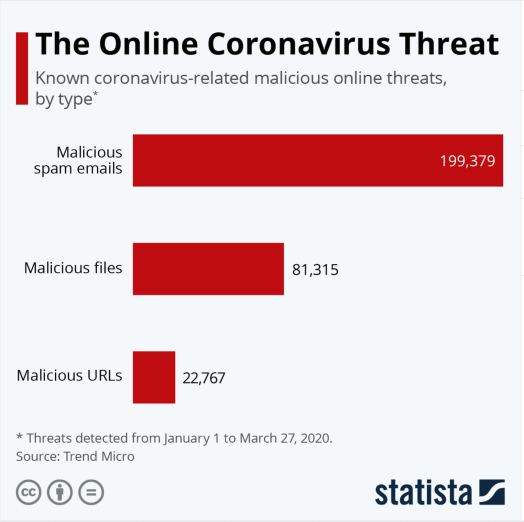
Since the start of the year there have been over 300 thousand unique online threats detected which attempt to take advantage of the coronavirus crisis and our desire for information on, and an end to, the pandemic. Be it in the form of malicious spam emails, files containing malware, or websites masquerading as governmental services.

The infographic below shows, malicious spam emails make up the largest share of the detected threats. Many of the emails, purportedly from official organisations, contain updates and recommendations connected to the disease.

However, like most email spam attacks, they also include malicious attachments.

Screenshot 2020-03-31 at 12.07.27

Residents are advised to beware of emails they are not expecting, some of these can look very plausible. One way of checking the authenticity of an email is to click onto the sender’s address and check it out. If your computer presents an abbreviated identification for senders of emails you need to click onto the sender field and select “show address”. If the address looks wrong  it’s almost certainly a scam email.

Websites can also be made to look like the real thing too, once again, check the full and exact web address being shown in your browser. Always make sure the web address you are using has the exact spelling. If in any doubt DON’T proceed with any transactions.

The key element to always remember is DO NOT open attachments or links – if the sender is a criminal any link or attachment in such an email is their way to get into at least some of your personal information. As always, vigilance is required in any actions undertaken online.

Please see below for more information on the most common COVID-19 frauds and the steps you can take to keep yourself safe.

Computer Software Service Fraud

As more people work from home due to #COVID19, fraudsters may capitalise on slow networks and IT problems, to commit computer software service fraud. Be wary of cold calls or unsolicited emails offering you help with your device or to fix a problem

Lender Loan Fraud

People may be worrying about their finances during the #COVID19 outbreak. Lender loan fraudsters will use the opportunity to:

– approve your application for a fast loan regardless of your credit history

– ask you to pay an upfront fee

– take your payment and never provide the loan

Pension Liberation Fraud and Investment Fraud

Fraudsters could try to take advantage of the financial uncertainty surrounding #COVID19 by offering people sham investment opportunities. If you get a cold call or unsolicited email offering you a deal that sounds too good to be true, it probably is.

Mandate Fraud

As more people work from home due to #COVID19, fraudsters may try to get you to change a direct debit, standing order or bank transfer mandate, to divert funds to their bank account, by purporting to be an organisation you make regular payments to.

Phishing

A number of #COVID19 related phishing emails have been reported to Action Fraud. These emails attempt to trick you into opening malicious attachments which could lead to fraudsters stealing your personal information, logins, passwords, or banking details.

Update 26/03: The Government has only sent one text message to the public regarding new rules about staying at home to prevent the spread of COVID-19. Any others claiming to be from UK Government are false.

“Criminals are able to use spoofing technology to send texts and emails impersonating organisations that you know and trust. We would remind anyone who receives an unexpected text or email asking for personal or financial details not click on the links or attachments, and don’t respond to any messages that ask for your personal or financial details.

Beware of Covid-19 Doorstep Caller Scams

CRIMINALS are using the coronavirus crisis to commit doorstep crime Warwickshire Trading Standards are warning in an alert issued on Thursday 26 March 2020.

Reports have emerged of people receiving unexpected doorstep visits from individuals offering to to buy or collect shopping on behalf of those who are self isolating. The thieves then take cash and do not return.

Residents are also advised to beware of rogue traders offering “doorstep cleansing services’ that offer to clean drives and doorways to kill bacteria and help prevent the spread of the virus.

Fake sanitisers, face masks and Cover-19 swabbing kits are also being sold door-to-door. These products can often be dangerous and unsafe.

Warwickshire Trading Standards advise:

  • DO NOT buy goods or services from unexpected and and unknown doorstep callers.
  • DO NOT reveal any sensitive information such as your bank card PIN number to any doorstep caller.

Please report any suspicious doorstep visits or any type of scam to the Citizens Advice Consumer Service on 0808 223 1133. Citizens Advice can provide telephone support and advice. They will also alert Warwickshire Trading Standards Service who can provide additional advice.

Courier Scam in Kenilworth using Covid-19 Situation

Warwickshire Police and Kenilworth’s Safer Neighbourhood Team are warning everyone to remain vigilant for themselves and others, particularly the vulnerable and elderly, after criminals tricked and stole thousands of pounds from a Kenilworth resident using the current Covid-19 emergency as a scam on Monday 23 March 2020. 

A resident at Rounds Hill in Kenilworth was contacted by telephone, the caller display showed “withheld number”. The offenders on the telephone call said they were police officers and wanted to do a ‘check’ concerning fraud.

The offenders then persuaded the householder into withdrawing £8000 from their bank account. The offenders told the householder to inform bank staff, if they questioned the withdrawal, to say that the money was to be given to a relative who is in self-isolation due to the Covid-19 emergency.

The description of the offender who then came and collected the money is female, 5″2, medium build with dark hair.

This is incident 267 of 23 March 2020

ADVICE FROM WARWICKSHIRE POLICE

  • Police Officers DO NOT call residents by telephone about bank/money fraud and indeed DO NOT call residents randomly. PUT THE PHONE DOWN if you receive such a call
  • NEVER withdraw money from your bank account on the advice of someone you do not personally know – THERE ARE NO CIRCUMSTANCES that make such a request legitimate.
  • NEVER hand over money or agree for someone to visit your address to pick up your bank/credit cards or to hand over money – POLICE OFFICERS never collect such things and anyone else that you don’t know who seeks to do so IS A CRIMINAL.
  • NEVER give you bank details or PIN details to anyone else, ANY phone call or caller at a door that seeks this information IS NOT GENUINE however plausible them might seem to be.
  • DO NOT ring a telephone number that any such caller gives you to check they are genuine and always make sure that you have a dialling tone when you pick your phone back up after receiving such a call – if you have not got a dial tone replace the receiver several times to clear the line.
  • If you receive any such then call Warwickshire Police on 101.
  • If you look after an elderly or vulnerable person please make sure they are made aware and take all appropriate steps to protect them from receiving these type of callers.

Kenilworth Watch

Neighbourhood Watch News for Kenilworth

Skip to content ↓